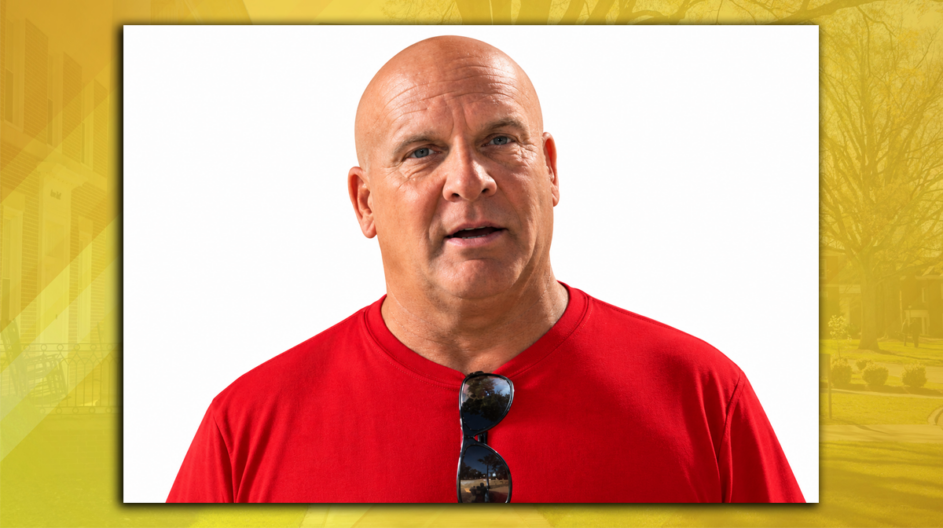
Pfeiffer Men’s Lacrosse Alumnus Finds Coaching Success
Bo Turner, a 1991 graduate of Pfeiffer College, once starred on the men’s lacrosse team of his alma mater. He has used that experience and the Pfeiffer coaches who shaped him to become one of the country’s most successful lacrosse coaches at the high school level.
This past spring, he coached Charlotte (N.C.) Catholic High School to its 500th win since 1994, the year he also founded the program. His teams have never had a losing season, and they’ve won five of the nine state championship games in which they’ve appeared. Several of his players have gone on to careers in college, including four who played on Division I national championship teams.
Turner has several explanations for this success. One has its origins in a philosophy espoused by the late Randy Mills, who served as the first head coach of the men’s lacrosse program at Pfeiffer, founding the program in 1984. Turner, who’s originally from Glen Burnie, MD, a lacrosse hotbed, played for Pfeiffer from 1985 until 1987, having been recruited by Mills.
“I try to be a player’s coach, like Mills,” Turner said. “He guided us but he let us have input. At Charlotte Catholic, I have an open conversation with my players and allow them to have a personality. I get a lot of positive responses when I do that.”
Turner said he often asks his players: “Guys, what do you want to do?” The answers have informed everything from how their uniforms will look to what they’ll do during spring break to the kinds of community events they hold to help the needy.
Turner’s players have bought into a commitment that includes playing in fall tournaments, offseason conditioning and weightlifting, and indoor lacrosse during the winter months. All this “makes such a difference,” Turner said. “We kind of build team camaraderie throughout the fall and winter. And then come spring, when the regular season begins, we have a good idea of what we have as far as team personnel goes.”
Turner is flexible. He stressed that he encourages his players to participate in other sports even if that means forgoing at least some of the offseason training regimen for lacrosse. He notes that the principles and skills gained in sports such as football, soccer, or basketball can reinforce what’s needed for success in lacrosse.
Although Charlotte Catholic is private, its athletic competition consists largely of public schools in the Southern Carolina 6A/7A Conference of the North Carolina High School Athletic Association. So, like their counterparts on opposing teams, coaches at Charlotte Catholic do not recruit and/or attempt to lure players with athletic scholarships. The participants in Turner’s program have gravitated to it because of the solid foundation their coach has built over a long period of time. This rests on what Turner learned as an assistant coach at Pfeiffer under James Fritz, who did so well as a coach of men’s lacrosse at Pfeiffer from 1990 to 2002 that he became a member of Pfeiffer’s Sports Hall of Fame in 2011.
And it derives from a desire to give back: After Turner graduated from Pfeiffer with a bachelor’s degree in economics, he moved to Charlotte, where he took up club lacrosse, befriending some fellow players who were fathers of students at Charlotte Catholic. They wanted a lacrosse program at Charlotte Catholic and asked Turner if he would start and coach one.
“I’d love to do that,” Turner recalls telling them. “I’m still there going into my 33rd year.”
Turner, who’s also the facilities director at Charlotte Catholic, has become quite busy, particularly during lacrosse season, when he arrives at work at 5:30 a.m. to address various maintenance issues and caps off a long day of work by leading practices or coaching games in the evenings. Now 60, he envisions relinquishing his position as head coach “in another year or two,” so that he can spend more time with his wife and son, traveling, hunting and relaxing in a cabin he owns in Virginia.
When the time comes for him to step away from the sidelines, a successor could emerge from the able assistant coaches he has groomed — including two who played lacrosse at Pfeiffer: Zach DeFazio ’24 and Hall of Famer Kevin Iwanusa ’98.
Turner will likely also look back with pride on the pivotal role he played in a startup program that helped put high school lacrosse, once largely confined to the northeastern United States, on the map in North Carolina.
“It’s been awesome to watch the program at Charlotte Catholic grow into what it is today,” he said.