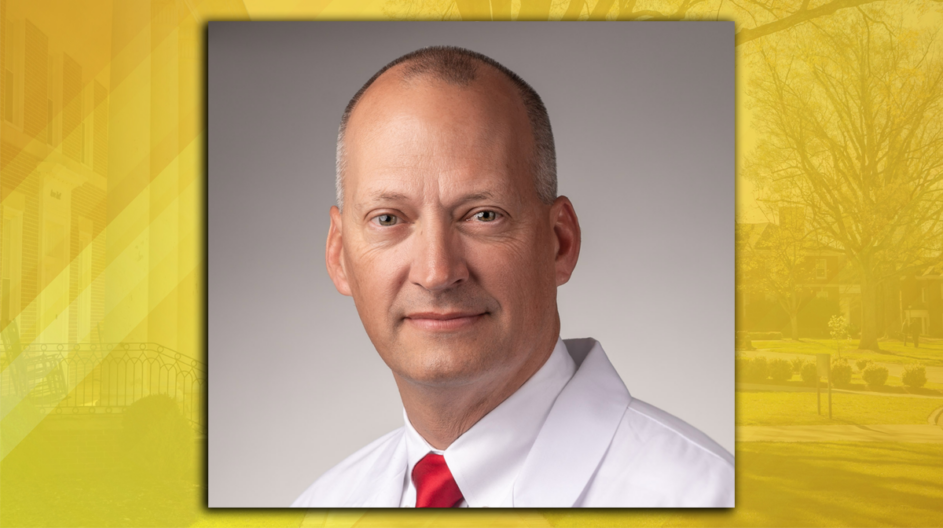
Calm in the Chaos: A Pfeiffer Alumnus Leads Through Crisis
“I’ve had a few chaotic days.”
Dr. Steve Shelton, a 1987 graduate of Pfeiffer College, uttered these words with disarming matter-of-factness on Jan. 23 in Columbia, S.C. He did so on the telephone during a work break at Prisma Health, his employer, where those “few chaotic days” would morph into several more of readiness, thanks to his able skills as an Emergency Manager for the health system. He’s been an Emergency Manager and an Academic Emergency Physician at Prisma Health for more than 30 years.
Shelton devised plans detailing how three hospitals in Columbia and another just outside that city would cope with the fallout from a then-imminent ice storm and from an outbreak of measles. This was quite the challenge, with Shelton taking into account everything from the 1,000 beds spread across the four hospitals to the 12,000 employees working at a 24/7 business that has to stay open, no matter what.
“We’ve got to make sure that everyone’s prepared,” Shelton said. “How do we get staff in and support them, things like that.”
Shelton’s duties as Emergency Manager last month also included providing updates and counsel for the public as a spokesperson for Prisma Health. It was a role he had undertaken several times before, one of the most notable happening in early 2022, when South Carolina experienced a rapid spread of the COVID-19 omicron variant that strained healthcare systems across the state. Shelton also shared clinical updates about the status of Prisma Health’s hospitals and made healthcare recommendations at press conferences that South Carolina Gov. Henry McMaster called in 2020, when COVID-19 was new. He served as leader (Incident Commander) for Prisma Health’s COVID response from beginning to end.
Shelton said that although his work as Emergency Manager has made him feel “overwhelmed” at times, “I’ve been doing this for a long time and I’ve been lucky enough to surround myself with some really sharp people.” He said he’s a big believer in listening to his colleagues’ concerns and making course corrections in response. “We adapt and overcome,” he said.
Shelton’s people skills began to develop at Pfeiffer, with which he was long familiar, having been raised in Stanly County. A chemistry major who minored in biology and math, he also took advantage of the many extracurricular activities on offer, particularly those that entailed serving in student government and various organizations. As President of the Male Student Association, to cite one example, he learned how to work through a range of issues with everyone from faculty to students.
“That experience was invaluable,” Shelton recalled. “I was able to build on it throughout my career.”
As for Shelton’s work as an Academic Emergency Physician, this, too, is rooted in his time at Pfeiffer, which he attended on scholarship. As a pre-med student, Shelton took a requisite course on Biochemistry, which was taught by Dr. Mike Riemann ’70 (Hon.) ’10 (Hon.), Professor Emeritus of Chemistry at Pfeiffer.
“Steve was serious about his academics,” said Riemann, who also served as Shelton’s advisor. “He asked the kind of questions that gave this professor confidence that he would do well no matter the endeavor.”
In Riemann, Shelton saw “a mentor and somebody I definitely respected.” He recalled that Riemann always went the extra mile for him and his fellow students: The door to the professor’s office – and even his faculty housing on campus! – always seemed to be open to anyone who needed help with overcoming the more daunting challenges of chemistry. Also, Shelton recalled that when it came to the campus lab, Riemann “would be there weekends or evenings making sure you had what you needed to complete the task you were given.”
After Pfeiffer, Shelton attended the East Carolina University School of Medicine, then, in 1994, completed an Emergency Medicine Residency at Richland Memorial Hospital/University of South Carolina School of Medicine in Columbia. At East Carolina, “the material wasn’t crazy-difficult,” Shelton said. “But the volume of the material was a lot greater and came at me a lot faster than was the case at Pfeiffer. Still, I felt that Pfeiffer had given me the skills to succeed.”
In time, Shelton would gravitate to emergency medicine as a specialty, having found “the opportunity to make quick fixes and to make an immediate impact on people’s lives” more to his liking than, say, managing a chronic condition over time.
He also came to feel energized by working with medical students (from the University of South Carolina), calling them “the best of the medical students who come to us.” And he has liked absorbing the new approaches and thinking that the residents under his supervision bring to the ER environment as he guides them not so much with orders but with questions (e.g., “Did you think about this?”).
In Shelton’s eyes, all this and more can be traced back to Pfeiffer, which he says provided him with a great foundation for what followed. “It got me where I needed to go,” he said.