Mentors, Moments and Grit: A Life Shaped by Pfeiffer
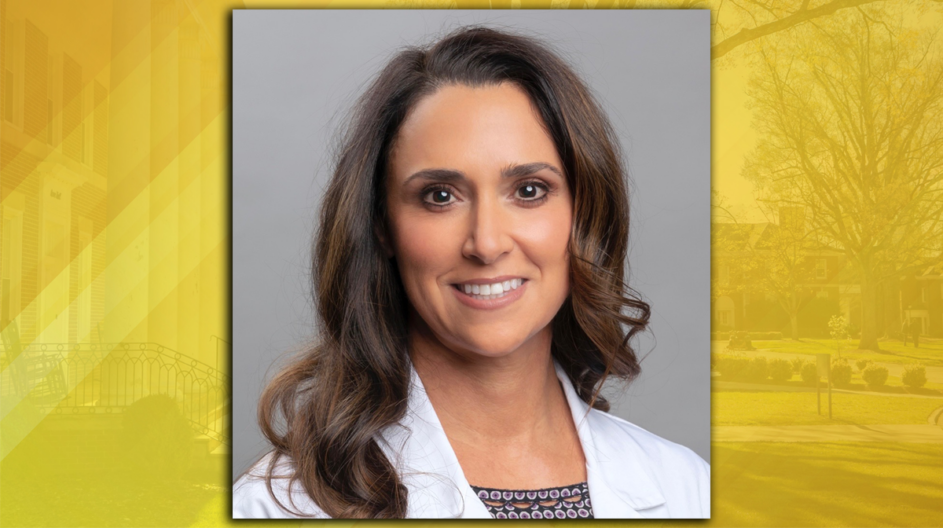
Dr. Stephanie (Ferri) Lewis MD, a 1994 graduate of Pfeiffer College, is an emergency medicine specialist affiliated with CoxHealth Emergency and Trauma Center in Springfield, MO, where she lives with her husband Thomas, also an emergency physician. She can trace much of her career success to her time at Pfeiffer, where she thrived as an unusually busy student-athlete, benefited from the mentorship of caring faculty and staff, and developed a good bit of grit.
She envisioned becoming a physical therapist when she first enrolled in her alma mater. She made sports medicine her major, believing it would move her closer to her career goal while complementing her multifaceted and exceptional abilities in athletics.
Lewis would certainly live up to her promise in sports while at Pfeiffer. Although initially recruited out of Cape Coral, Fla., to join the women’s swim team, she would end up running cross country for four years as well, and she began playing women’s soccer in 1993, the year Pfeiffer began offering it. She performed superbly well in each sport she played and was inducted into Pfeiffer’s Sports Hall of Fame in 2007.
However, she started gravitating away from her goal of physical therapy almost immediately, thanks to Dr. Steve Dial ’59 (1937-2012), the legendary Professor Emeritus of Biology. Dial, who taught a course Lewis took during her first semester, pulled her aside one day about a month after classes had started and asked if she’d ever considered becoming a medical doctor.
“I kind of laughed,” Lewis said. “I didn’t have any family in medicine. It had never occurred to me.”
Dial urged Lewis to keep her options open for a future at medical school by taking enough classes in biology to make it a second major. She followed Dial’s advice and remains glad she did.
“The more biology I did, the more I liked it,” Lewis said. “I really attribute the one conversation my freshman year with Dr. Dial to almost my entire career. He completely changed my path.”
Lewis also took several courses in Chemistry, further solidifying a foundation she’d need for medical school. During her senior year, she took an elective that enabled her to shadow several doctors; her shadowing of an emergency physician piqued her interest in following in his footsteps.
Lewis’ life at Pfeiffer became incredibly busy, packed with sports as well as the demanding courses in the sciences. She remembers that Pfeiffer professors and staff went above and beyond to ensure that she could work everything into her schedule seamlessly.
“Pfeiffer just really supported me,” she said. “They enabled me to do so much more than I should have ever been able to do in college.”
Dr. Mike Riemann ’70 (Hon.) ’10 (Hon.), Professor Emeritus of Chemistry at Pfeiffer, emerged as Lewis’ principal mentor during her junior and senior years. He recalled recently that she “usually had a plan when she came to my office and if the interaction was about my class, she had a list of questions in hand.”
“She is among the most determined students I have had over 38 years of teaching and is probably the most organized,” he added.
Lewis would draw on these qualities when she began attending the Ross University School of Medicine, where, historically, students have completed their initial foundational medical sciences curriculum in the Caribbean. They then finish their core and elective clinical rotations at affiliated teaching hospitals across the United States.
While at Ross, Lewis took classes on Dominica, an island nation. She contended with three hurricanes during the first three weeks she was there.
“We lived by a river where we would wash our clothes and we’d bring buckets of water back up to the house to flush the toilets,” she said. “It was interesting to say the least.”
In the end, Lewis never wavered in her belief that she would surmount these challenges because of all she managed to accomplish in an unusually demanding environment at Pfeiffer.
All told, Lewis has been an emergency physician for 27 years. Her career has included brief stints of work on her hospital’s board and as a pediatric medical director. She finds it helpful that she and her husband have been a part of their community for a long time and are, therefore, well known to potential patients and the specialists they might need.
“It just seems like there’s not a day that goes by that someone we know isn’t calling us up and saying, ‘Hey, we’re headed in. Are you guys working?’” she said. “So, we just know that we’re a good connection for people.”
Over time, Lewis has had to account for a myriad of issues her patients are facing beyond their immediate medical concerns. Many are unhoused, caught up in human trafficking, or addicted to methamphetamines.
“Sometimes it is more the social situations than the actual medical problems that speak to me and that I find challenging or that make me work a little harder as a physician,” she said. “And then there are challenges of healthcare nowadays; that hospitals are run as businesses makes everything a little more challenging.”
Lewis remains physically active. She is a long-distance runner and has run several marathons. A few years ago, she ran her first Boston Marathon. In 2022, she and her husband climbed to the Mt. Everest base camp in Nepal as a way to learn more about expedition medicine, and last summer, she climbed Mount Kilimanjaro with her family. The couple has two sons.
She remains grateful for her student days at Pfeiffer and has given back. She became what Riemann called the “principal driver” behind the Reimann Robertson Manly Research Endowment, the annual earnings of which fund an award for the most outstanding undergraduate research project as well as stipends for undergraduate research opportunities.
“I have a pretty great life,” Lewis said. “I’ve gotten to do a lot of really neat things, and it certainly started with Pfeiffer.”