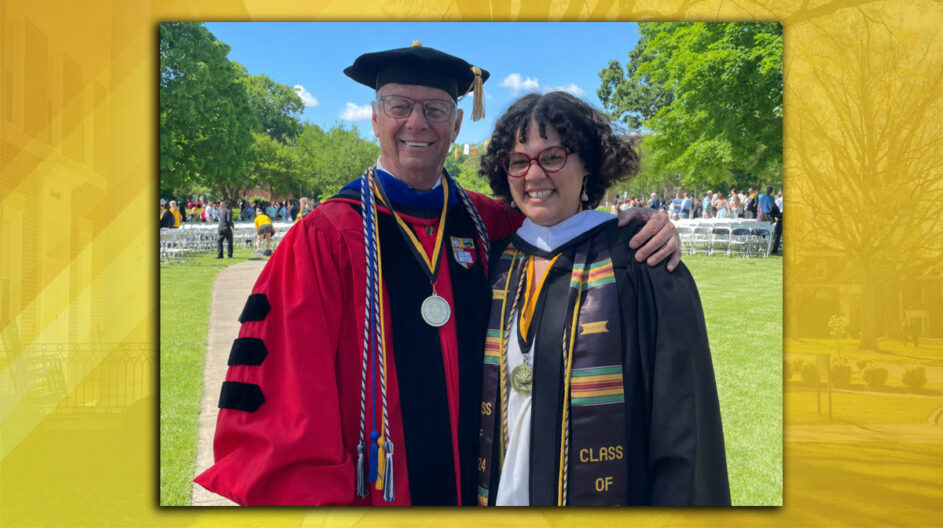
Pfeiffer Professor Retires from a Perfect Fit
Professor of Psychology Dr. Don Poe participated in his last Pfeiffer graduation ceremony earlier this month. He says he owes his distinguished career to several factors. The first was his response to a false start in the 1960s during his first two years at Duke University. He had enrolled in its College of Engineering (now the Edmund T. Pratt Jr. School of Engineering), having followed the advice of his high school guidance counselor in northern Virginia.
The counselor had told Poe that the country needed more engineers. Poe wouldn’t become one of them. After his sophomore year, he showed his father his poor grades and told him that he hated engineering. “I think it hates you back,” Poe’s father said, showing a sense of humor that Professor Poe not only inherited but would also make an attractive hallmark of his lectures at Pfeiffer.
Ava Lowder ’28, a rising junior at Pfeiffer from Mt. Pleasant, N.C., is a psychology major who took several courses taught by Poe. She said that he communicated not only with humor in the classroom but also with “passion and authenticity.”
“He captured people’s attention when he spoke,” she added. “He had many unique stories that people genuinely wanted to listen to, and he knew how to connect those stories to classroom material as well as meaningful life lessons. He also created an environment where students felt comfortable participating rather than being afraid of making mistakes.”
Poe’s move away from engineering to psychology took hold during an excellent introductory course in psychology at Duke, from which he earned a B.A. degree in the subject, in 1968. The course included six hours of research and several experiments, for which Poe was the subject. “I fell in love with it,” he said. “I concluded that studying people was great because I love people.”
Poe also holds two advanced degrees in social psychology, which he earned after a stint in the U.S. Navy: a master’s degree from Virginia Polytechnic Institute and State University and a doctorate from Cornell University, which he earned in 1980.
He tried very hard to make his introductory courses at Pfeiffer, where he began teaching in 2004, just as appealing as that very first Duke course. And in large part he has succeeded: psychology consistently ranks fifth or sixth at Pfeiffer, in terms of the numbers of students majoring in the subject. They’re drawn to it for several reasons: It can be really interesting, its required semester hours (40) enables students to make it part of a double major, and, as Poe became adept at communicating, it is useful in any number of fields, not just counseling and experimental psychology.
“I’m just trying to show them again and again that all this stuff that we talked about isn’t just for the exam,” he said. “You can use it.”
The students contemplating careers involving research could find an excellent example in Poe, who has published numerous papers and given invited addresses on a range of subjects, from “Customs Officials and Their Search Decisions” to “The Salem Witch Trials.”
The piece on the search decisions of customs officials (1980), written with Robert Kraut, has been described as “a landmark study” examining how people evaluate truthfulness in real-world scenarios, specifically analyzing the behaviors that influence decisions to search people going through customs. Among other things, it found that search decisions were driven less by actual guilt than by perceived comportment (nervousness, demeanor).
Although Poe can point to numerous academic accomplishments at Pfeiffer, he says he’s most proud of the social relationships he has forged with his students and colleagues. He loves singing and playing the guitar, for example, having become a mainstay of a faculty bluegrass band called Brain Trust.
He recently spent an hour or so with Lowder talking about her interests and recommending books she might read to learn more. He’s an inveterate reader himself, mostly of nonfiction. One of the books he suggested was Poe’s own Huh. I Didn’t Know That, which she described as “similar to a trivia book but it includes short stories, not just questions and answers.”
Poe has attended the weddings of five or six students. He has 398 Facebook friends and guarantees that at least 95 percent of them have a connection to Pfeiffer. “I’m accepting applications for a couple of more Facebook friends from the Pfeiffer family,” he joked recently. “Pfeiffer grows on you,” he added. “We call ourselves a family, and after a short while, I came to believe it. Basically, all of my friends are at Pfeiffer. It’s just been the perfect fit for me.”