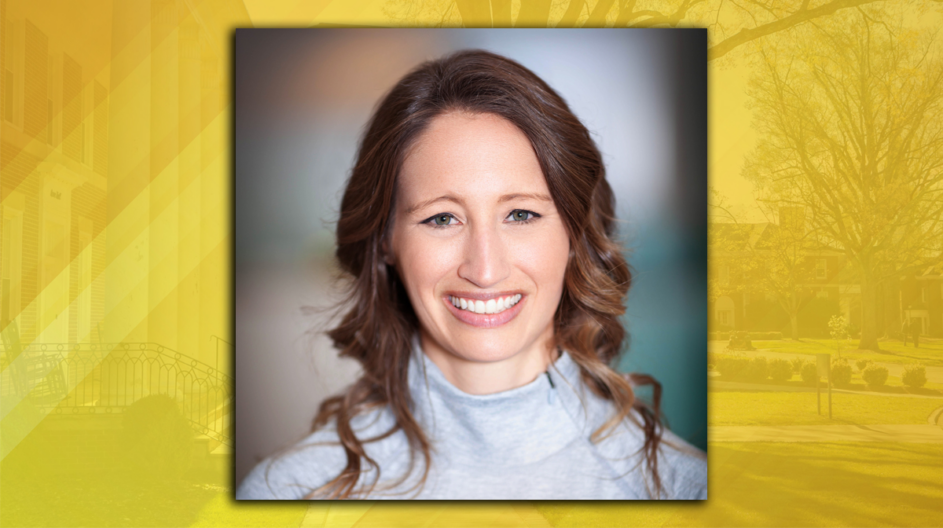
Alumna Finds Purpose in Redefining Exercise for Every Body
Carolyn Mueller ’05 grew up near the Pfeiffer University campus, in Badin, N.C. Her parents met at Pfeiffer: her father, David, is a 1976 graduate and her mother, Kati, attended in 1974. Before Carolyn herself became a Falcon, her older brother, Steven, attended for two years before transferring.
During her sophomore year, as she was pursuing a B.S. degree in Health and Exercise Science, Mueller ’05 learned that her mother had developed a serious neurological condition that dramatically affected her mobility. This was awful news, of course, but it would also have a profoundly positive effect on the trajectory of Mueller’s current career in Chicago as a clinical exercise physiologist, wellness coach and personal trainer.
Initially, Mueller envisioned putting her Pfeiffer major to use in ways that might enhance the strength and conditioning of fellow athletes and movement enthusiasts. She started as a midfielder over four years on the women’s soccer team, and when she wasn’t on the pitch, she liked to keep moving.
However, as she observed her mother’s rehabilitation and the limited resources available once formal rehab ended, her perspective and aspirations in the exercise space shifted.
“I realized that there was a whole other population that I was completely overlooking,” she said. “In time, I developed a passion for working with special populations, which include individuals with physical disabilities, neurological conditions, chronic illness, and those who may require modified or highly individualized approaches to exercise.”
Her clientele in Chicago, where she’s lived since 2008, has included many people drawn from special populations, in addition to professional athletes, corporate executives and soccer moms. She works as a part-time exercise physiologist at Northwestern Medicine Executive Health and as a personal trainer at Carolyn Mueller Fitness, a high-tech business she started in 2018 with the goal of offering a personal-training package to suit every taste, lifestyle and location, including some internationally-based clients.
During a recent interview, Mueller described how Pfeiffer planted the seeds for the professional she would become. She illuminated her approach with special populations and how it has influenced the way she works with all kinds of clients. And she described her life in Chicago.
Carolyn, thank you for granting us an interview. Pfeiffer was pretty much always on your radar as you grew up. Why did you decide to attend the University?
My family’s connection to the school played a role, as did the fact that I often watched Peiffer’s soccer teams play and attended soccer camps on campus. Knowing Coach Chad Miller, who was a family friend, also influenced my decision to choose Pfeiffer. In short, Pfeiffer was familiar, it offered exactly what I was looking for, and it already felt like home.
Who were your most important professors at Pfeiffer and how did they influence you?
Two professors stand out as especially influential during my time at Pfeiffer. One of my most memorable was Dr. Don Jackman ’78 (Hon.), now a Professor Emeritus of Chemistry at Pfeiffer. Chemistry was not my strongest subject and apparently not a strength for my dad or older brother either. When I first met Dr. Jackman, he joked, “Oh… another Mueller. I hope you’ll be the first in your family to pass my course!” That comment motivated me to work incredibly hard, and while all of us like to say we “barely passed,” it was a meaningful lesson in perseverance and rising to a challenge.
The professor I would especially like to thank is Dr. Vins Sutlive (now the Chair of the Department of Natural Science and Allied Health at Asbury University in Wilmore, KY). He taught many of my science-based courses and served as a wonderful advisor. Beyond being an excellent professor, he was a genuinely kind and supportive person. He listened, encouraged me academically, and helped me stay motivated during challenging times. I’m particularly grateful for his support of my family, including helping connect us with resources to assist my mom with home exercise following her injury. He truly went beyond the role of a teacher, and I remain very thankful for his impact on my life.
How did Pfeiffer plant the seeds for the kind of exercise physiologist and personal trainer you have become today?
Sports and movement were always a big part of my life and helped keep me motivated and moving forward from a young age. When I arrived at Pfeiffer, that interest was given structure and depth. As an Exercise Science major, I learned the science behind movement, not just that the body moves, but how and why it does. Learning anatomy, physiology, and biomechanics made the human body endlessly fascinating to me and sparked a desire to keep learning. In short, Pfeiffer helped me connect my love of sport and movement with evidence-based practices, a philosophy that I follow to this day. I hasten to add, though, that other important experiences beyond Pfeiffer also shaped the exercise physiologist and personal trainer I am today.
How so?
Well, two important experiences come to mind, and they’re both related to my work with special populations. The first grew out of field work that Dr. Sutlive arranged for me to do at the Stanly County Family YMCA. After teaching a women’s sports conditioning class there, Y director John Fields took me under his wing and gave me opportunities that shaped my career path. The most impactful was working with individuals who had intellectual and physical disabilities. That population pushed me to think differently about movement, to be creative, adaptable, and open to alternative ways of accomplishing goals when the “traditional” approach didn’t work. It taught me patience and empathy, but more importantly, how to truly motivate, support, and meet someone where they are.
My work at the Stanly County Y would pave the way for my doing an unpaid internship in summer 2007 at what is now the Shirley Ryan AbilityLab (formerly the Rehabilitation Institute of Chicago). Thanks to the support of my family, I spent my first summer in Chicago at what is widely considered one of the best physical rehabilitation hospitals in the country. That experience confirmed that this was the environment where I wanted to continue learning and growing.
And after I earned my master’s degree in kinesiology, nutrition and physical activity from James Madison University in 2008, I became the Manager of Adaptive Fitness Services at the Shirley Ryan AbilityLab, a post I held until 2013. In that role, I worked closely with physical therapists and a team of exercise physiologists to help maximize each patient’s care and ensure carryover beyond formal rehabilitation. That collaborative mindset strongly influences how I work today. I’m always thinking about appropriate modifications and progressions, adjusting in real time, and making sure each program aligns with an individual’s needs and goals. Whether in a clinical setting or a personal training environment, my focus is on helping people move forward with confidence. I call it “Modify and Progress,” and I’ve compiled a short video that illustrates how I approach modifying and progressing, using a common exercise, namely the push up.
It appears, then, that Chicago has been a good place for you to further your career.
Absolutely. The city offers extensive resources, multiple healthcare systems, and a strong emphasis on interdisciplinary collaboration. Being in an environment where physicians, physical therapists, and other clinicians actively seek out qualified exercise professionals has allowed me to build meaningful connections and provide continuity of care for many patients. I’ve also been fortunate to work with wonderful clients, and over time my practice has grown largely through word of mouth, which speaks to the strength of the professional community here.
What about the winters?
While my first Chicago winter was intimidating, I’ve since grown to love the city, no matter how cold it gets. The professional experience I gained early in my career was transformative, and Chicago became home, helped along by meeting a wonderful Canadian who is now my husband: Dr. Levi Hargrove. He holds two positions at Shirley Ryan: he leads the Regenstein Foundation Center for Bionic Medicine, and serves as Director of the Neural Engineering for Prosthetics and Orthotics Lab. And he taught me how to survive the colder months.