Peters Named 2026 Presidential Merit Award Winner
How is Methodism evolving in the country of its birth?
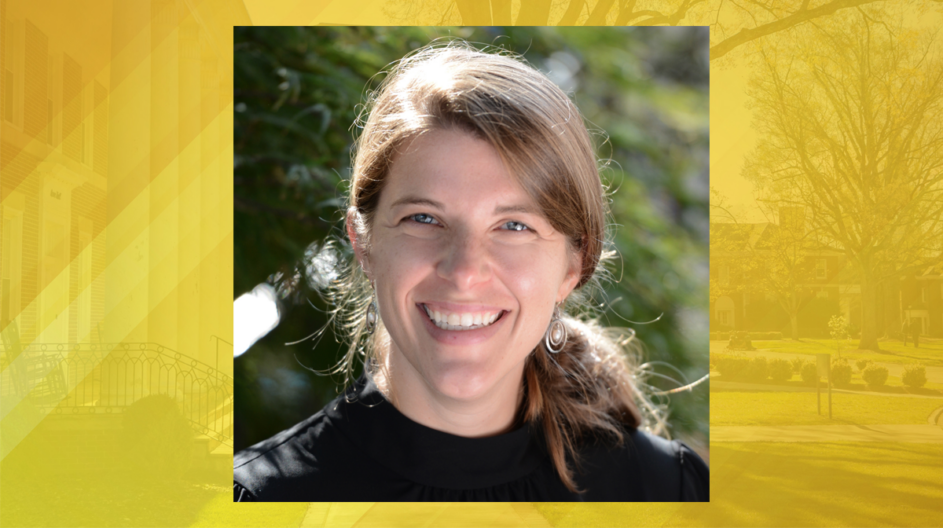
Reverend Meg Gaston Peters ’13, the recipient of Pfeiffer University’s 2026 Presidential Merit Award, is providing some intriguing answers. She has been working in England for the British Methodist Church as one of its Ministers of Other Churches, having committed to do so over a five-year period that began in September 2025.
She once aspired to teach math, having majored in that subject while minoring in secondary education. After deciding a career as a math teacher would not be for her, though, she earned a master’s degree in Divinity/Ministry from the Princeton Theological Seminary in Princeton, N.J. and was ordained as a minister in the United Methodist Church. Before her appointment in England, Peters pastored two churches in her native North Carolina, and she served as Associate Minister of Outreach at Centenary United Methodist Church in Winston-Salem, N.C.
Her decision to move to England with her husband Luke, a house painter, has its roots in her longtime desire to experience “God and religion in different places” and to see “how different people worship and what that means to them.” Before entering seminary, she participated in three mission trips during her student days at Pfeiffer (one was to Cuba, the others to Guatemala and Kenya). She also served as a Global Mission Fellow for UMC’s Global Ministries programs in South Korea and Japan.
In England, she’s officially responsible for four churches in the Cleveland & Danby Methodist Circuit, three of them in Redcar, a seaside town on the Yorkshire Coast in northeastern England. Her duties away from the pulpit include officiating at funerals and weddings, visiting hospitalized members of each circuit church, and addressing various issues at meetings.
Peters has become unexpectedly busy of late. A lay pastor of three additional churches in her circuit is retiring, so these will soon be added to her pastoral charge.
“This will be the case until a replacement is found,” Peters said. “But it’s okay. We’ve gotten very good at just rolling with wherever the current is going here.”
That “current” keeps Peters moving about. As a Minister for the British Methodist Church, she does not preach at the same church every Sunday. Instead, following a tradition begun by Methodism founder John Wesley, she engages in “circuit preaching,” which means she leads worship and delivers a sermon at a different circuit church each week.
When Peters isn’t leading a service at a circuit church, that duty falls to either a “local preacher,” who may preach a sermon in addition to leading a service, or a “worship leader,” who is not authorized to preach.
This scenario is not without its challenges. Peters has sometimes struggled to remember the names of congregants she sees only occasionally.
“It’s easy for them to remember my name because I’m the only American minister,” Peters said. “By contrast, I’m often saying, like, ‘Oh my goodness, I’m so sorry, but what’s your name again?’”
Another challenge circuit preaching presents to Peters lies in the need for her to adapt each of her sermons to the unique contexts of different congregations, which worship in both rural and coastal locations. Instead of connecting sermons thematically over several Sundays at the same church, she now seeks to tailor messages that will resonate with a different audience (farmers and fishermen, for example, or doctors and lawyers).
“I’m always trying to think of where a community is and what a sermon could mean to them,” Peters said.
In some instances, too, the number of people in a sanctuary for a service is quite low. When that happens, Peters won’t mount a pulpit and deliver a sermon; instead, she’ll join worshippers at a table for a more casual “cafe” service, where singing and discussions happen over tea and cakes. Although such a format took some getting used to for Peters, she enjoys the opportunity of “having a conversation.”
In addition to adjusting to the English variety of Methodism, Peters is also learning how to live more effectively in a foreign country. This has entailed learning that the English don’t eat fries but “chips” and that cookies are “biscuits.” And when she needs to throw something away, she asks not for a trash can but for a “rubbish bin.”
Sometimes, thick accents have been a particularly daunting challenge for Peters, prompting her to ask: “I’m so sorry. Can you spell the word you’re saying?”
All in all, though, Peters and her husband, who’s been busy painting, seem to be off to an auspicious start in their new church home. “We’ve been here for about a year, and we’ve really enjoyed it,” she said. “All of our family lives in the States, so at some point, we’ll probably move back there. But I wouldn’t be surprised if down the road, we end up in another country.”