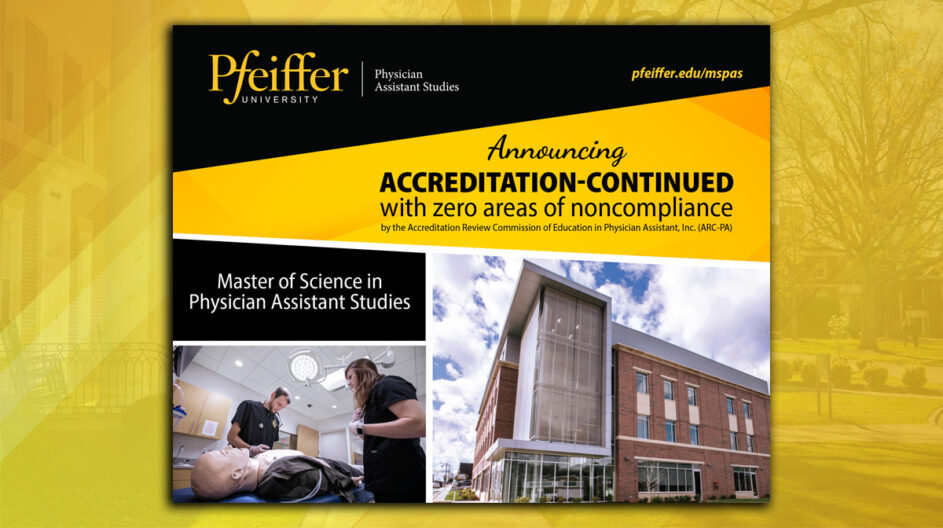
Pfeiffer University Physician Assistant Program Earns Accreditation – Continued Status
Milestone strengthens University’s commitment to preparing healthcare professionals to serve North Carolina communities
Pfeiffer University’s Physician Assistant Program has earned Accreditation – Continued status from the Accreditation Review Commission on Education for the Physician Assistant, Inc. (ARC-PA), with zero areas of noncompliance, marking an important milestone for the program and North Carolina.
Accreditation – Continued is granted when a currently accredited program is in compliance with ARC-PA Standards. For Pfeiffer, this achievement matters because physician assistants can help meet healthcare needs statewide, especially in rural communities.
Preparing PAs to Meet North Carolina’s Healthcare Needs
A 2025 analysis of North Carolina’s primary care workforce found 52.6 physician assistants per 100,000 residents in rural counties, compared with 97.3 in urban counties, highlighting a significant rural-urban difference in the availability of physician assistants.
For rural North Carolinians, access to health care often begins with having qualified providers close to home. Pfeiffer is helping prepare the next generation of healthcare professionals to meet those needs, with more than 76 percent of its PA students and alumni calling North Carolina home.
“This achievement reflects not only the strength of the program, but Pfeiffer’s continued commitment to preparing compassionate, highly qualified healthcare professionals who will serve patients and communities with skill and purpose,” said Scott W. Bullard, Ph.D., Pfeiffer University President.
A Collective Commitment to Excellence
The milestone follows significant work by Pfeiffer’s PA faculty and staff, as well as University leadership. President Bullard specifically recognized Dr. Scott Fisher, Anne Louise Keeney Chair, Program Director and Associate Professor of Physician Assistant Studies, and Dr. Christopher Boe, Dean of the Graduate School, for their leadership throughout the accreditation process.
Pfeiffer PA students complete more than 1,900 hours of supervised clinical practice, providing extensive preparation before entering the profession. And 99 percent of Pfeiffer’s PA graduates have become certified physician assistants.
“This achievement belongs to our entire PA community,” Fisher said. “Our faculty and staff have worked with tremendous dedication to prepare students for the responsibilities of the profession, and our students and graduates carry that commitment into the communities they serve.”
Boe agreed. “This accreditation milestone reflects sustained work across the program and the University, as well as the important role of our regional healthcare partners who provide clinical experiences for our students. Together, these efforts provide a strong foundation as we continue preparing the next generation of healthcare professionals.”
Building for the Future
Pfeiffer’s PA program is part of the University’s broader commitment to preparing graduates for lives of achievement, scholarship, spirituality, and service. Through rigorous academic preparation and supervised clinical experiences, students are prepared to enter a profession that is integral to healthcare delivery across North Carolina and beyond.
ARC-PA lists Pfeiffer’s next validation review for October 2034, contingent upon continued compliance with accreditation standards and ARC-PA policy.